If you’re pulling a building permit in California, Title 24 isn’t optional. It’s a required part of the permit package and it applies to almost every project that involves new construction, additions, alterations, or changes to mechanical, electrical, or plumbing systems.
What surprises a lot of contractors and homeowners is how often Title 24 becomes the bottleneck. The architectural drawings are done, the structural is stamped, the MEP is coordinated and then the energy compliance report comes back with issues, or it was never started, and the submittal has to wait.
At Fast-Build, Title 24 compliance is part of our standard process on every California project. We prepare compliance documentation as an integrated part of the permit package not as an afterthought. For clients who already have drawings from another firm and just need the energy compliance piece, we also handle that as a standalone service.
Title 24 is California’s Building Energy Efficiency Standards a set of requirements that govern how much energy new and renovated buildings are allowed to consume. It’s updated roughly every three years, and the current version is among the most demanding in the country.
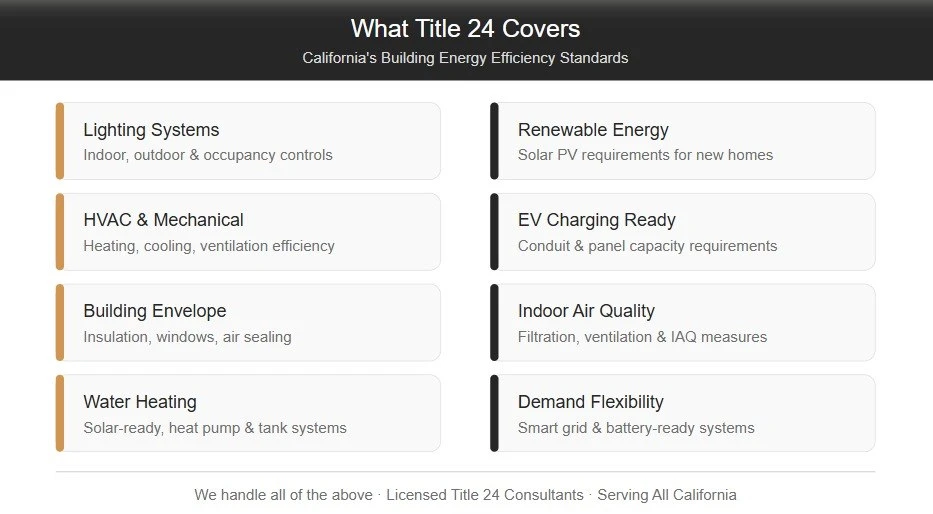
It covers three main areas:
Envelope performance — insulation levels, window U-values and solar heat gain coefficients, air sealing requirements, and cool roof specifications. The building’s shell is the first line of energy defense, and Title 24 sets minimum standards for how well it performs.
Mechanical systems (HVAC) — equipment efficiency ratings, duct sealing, ventilation requirements, and thermostat controls. For commercial projects, this includes demand-controlled ventilation, economizers, and zoning requirements.
Lighting — interior lighting power density limits, mandatory controls (occupancy sensors, daylight controls), and exterior lighting requirements. Title 24 lighting compliance is one of the most common areas where projects get flagged during plan check.
For residential projects, water heating systems including solar-ready requirements and heat pump water heater mandates under the latest code cycle are also covered.
Almost anyone pulling a permit in California.


We offer Title 24 compliance two ways:
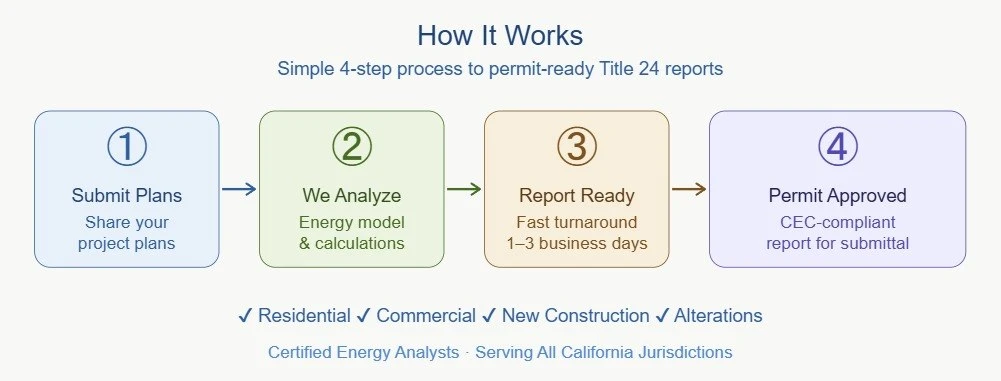
As part of a full permit package — For projects where we’re preparing the architectural, structural, and MEP drawings, Title 24 is included and coordinated with the rest of the set. The compliance documentation is built around the actual design — not generic assumptions — which means fewer issues during plan check.
As a standalone service — If you have drawings from another architect or designer and just need the Title 24 compliance report, we can prepare that independently. You send us the drawings, we run the calculations and prepare the required forms, and you add them to your permit submittal.
Using the wrong code cycle. California updates Title 24 every three years. Compliance reports prepared under an older code cycle even by just one cycle won’t be accepted. We always work under the current applicable standards.
Generic assumptions that don’t match the design. Some compliance reports are prepared using default values that don’t reflect the actual project generic insulation, standard window specs, placeholder HVAC equipment. When the plan checker or HERS rater compares the report to the actual drawings and specifications, the discrepancies cause problems. Our compliance documentation is based on the actual design.
Missing mandatory measures. Title 24 has a long list of mandatory measures that apply regardless of whether you’re using prescriptive or performance compliance. Missing even one an occupancy sensor requirement, a damper detail, a cool roof specification can result in a correction notice.
Commercial lighting compliance errors. Commercial lighting compliance is one of the most frequently flagged areas in TI and commercial new construction plan check. Power density calculations, control requirements, and exterior lighting compliance all need to be documented correctly.
Residential HERS verification not planned for. Some residential compliance approaches require field verification by a HERS rater an independent third party who verifies that the installation matches the compliance documentation. If this requirement isn’t planned for during design, it can create problems after construction starts. We flag these requirements upfront.
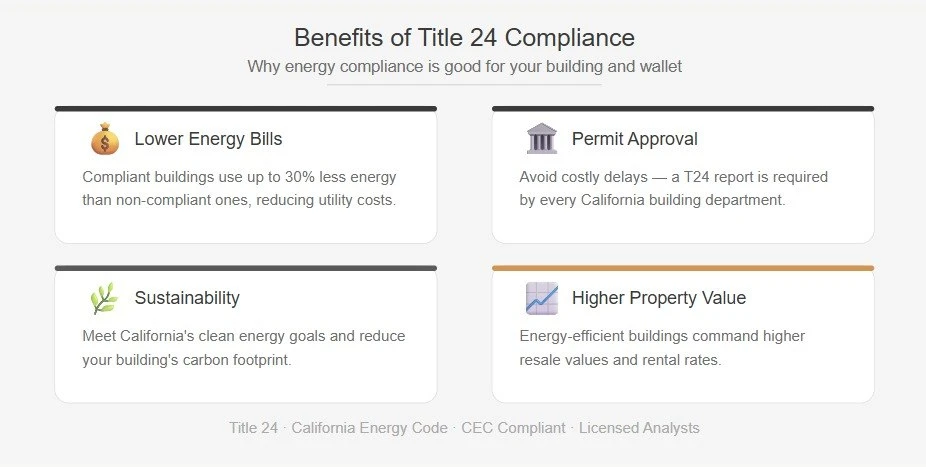
California’s Title 24 requirements have become significantly more stringent over the last several code cycles, and that trend is continuing. The 2022 code cycle introduced new requirements for solar-ready construction, heat pump water heaters, EV charging infrastructure, and all-electric or electric-ready design for new residential construction.
The practical implication: compliance reports from even a few years ago may not meet current requirements, and projects designed under older assumptions may need to be revisited before permit submittal. We work under the current code cycle on every project and can identify where older designs may need to be updated.

For a straightforward residential project, we can typically deliver a compliance report within 3 to 5 business days once we have the drawings and project information.
Commercial projects and performance compliance modeling take longer typically 1 to 2 weeks depending on complexity.
Yes. This is one of the most common requests we get for this service. Send us the drawings, specifications, and any relevant project information, and we’ll prepare the compliance documentation.
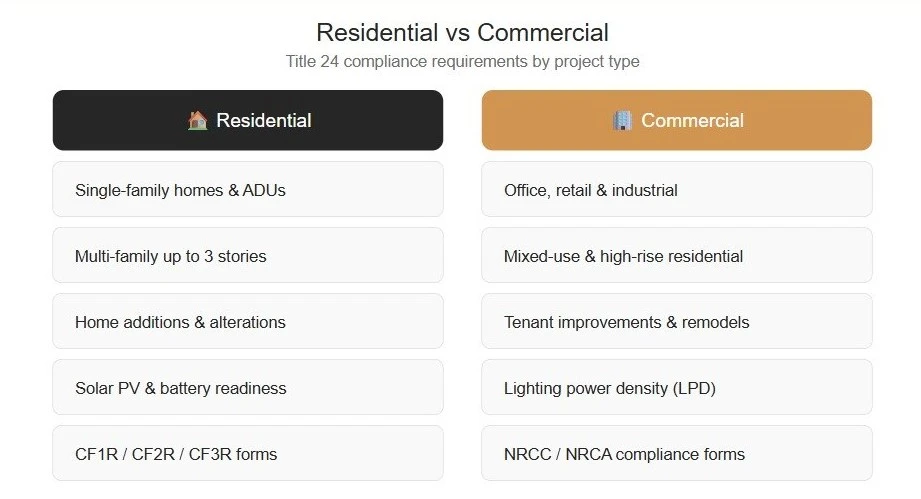
Residential: floor plans, window schedule, insulation specifications, HVAC equipment specs, and water heater information.
Commercial: floor plans, reflected ceiling plan, lighting fixture schedule, HVAC equipment schedule, and envelope specifications.
Title 24 is California-specific. Other states use their own energy codes typically IECC. For projects in Washington, Florida, Arizona, and other states, we prepare compliance documentation under the applicable state energy code.
Prescriptive compliance means the project meets a set of fixed requirements specific insulation values, window specs, equipment efficiencies. Performance compliance uses energy modeling software to show that the proposed design uses no more energy than a reference building that meets the prescriptive requirements. Performance compliance gives more design flexibility but requires more detailed analysis. We use both approaches depending on what the project requires.
If the compliance report shows the design doesn’t meet the standard, we work with you to identify what needs to change whether that’s upgrading insulation, specifying higher-efficiency equipment, or adding lighting controls. For projects where we’ve prepared both the design and the compliance documentation, these issues are typically caught and resolved before the report is finalized.
Book a free consultation and get expert guidance on your project, timeline, and permit requirements.
San Diego Office
4653 Carmel Mountain Rd, Ste 308
A191
San Diego, CA 92130
Dubai Office
Office 3027, 30th Floor
Al Moosa Tower 2
Sheikh Zayed Road
Phone
© 2026 Fast Build. All rights reserved.
Book a free consultation and get expert guidance on your project, timeline, and permit requirements.
Adding {{itemName}} to cart
Added {{itemName}} to cart