
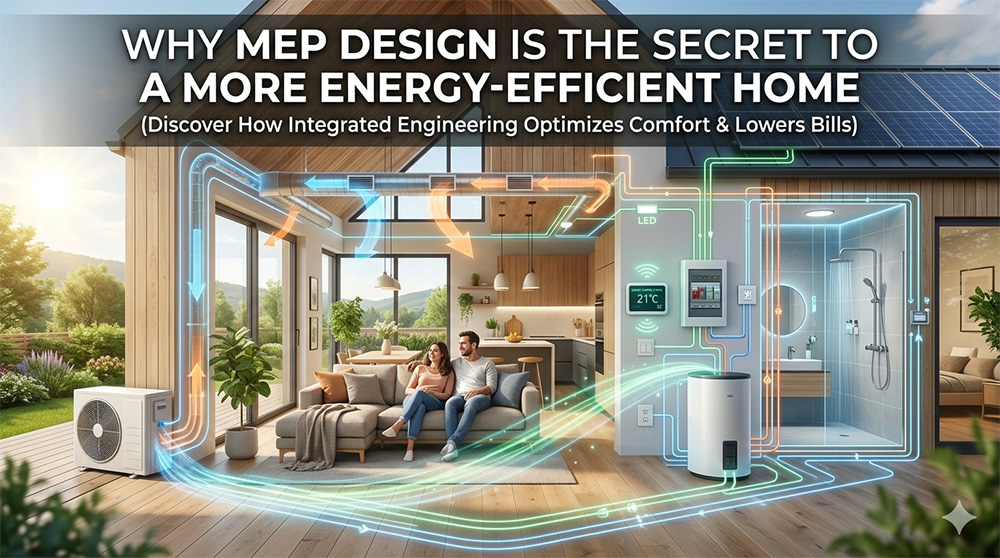
Imagine living in a stunning modern home with beautiful architecture, top quality materials, yet still facing shockingly high energy bills every month. It’s more common than you think. Even the best-designed homes can waste energy without you ever knowing why.
We’ve all felt it: on a hot day, the AC runs at full power but the air stays heavy. In winter, the heating takes forever to warm the space. Even small frustrations add up, lights that stay on too long, a slow hot water system that quietly wastes energy. And over time, all of it shows up in one place: the energy bill.
But why does this happen?
Where does all the energy go to?
What’s the solution for this energy waste?
What is MEP?
The MEP systems are the essential components which allow a building to function properly. While architecture defines the form and aesthetic of a structure, MEP systems determine how a building actually operates on daily basis. These systems control heating, cooling, ventilation and water distribution throughout the building. They also play a critical role in a building’s comfort, safety, and energy performance while they’re hidden behind the walls, ceilings, and floors. When these systems are carefully designed and properly integrated with the architecture, they can significantly improve a home’s energy efficiency and reduce overall energy consumption.
Honestly, most homeowners don’t even think about what’s inside their walls until something goes wrong.
Components of MEP Systems
As you may have understood so far, MEP systems are generally divided into three main components, each responsible for a different function within a building.
- The Mechanical system mainly includes heating, ventilation, and air conditioning (HVAC), which controls indoor temperature, air quality, and overall comfort.
- The Electrical system covers power distribution, lighting, emergency systems, and all electrical loads within the building.
- Lastly, the Plumbing system handles water supply, gas, drainage, and waste management, ensuring clean water delivery and proper removal of wastewater. Together, these three systems work behind the scenes to keep a building functional, comfortable, and efficient.
For San Diego projects, the energy modelling behind these decisions is documented in your Title 24 energy calculations in San Diego, which the city requires with your permit submittal.
Actual Energy Use Locations in a Building
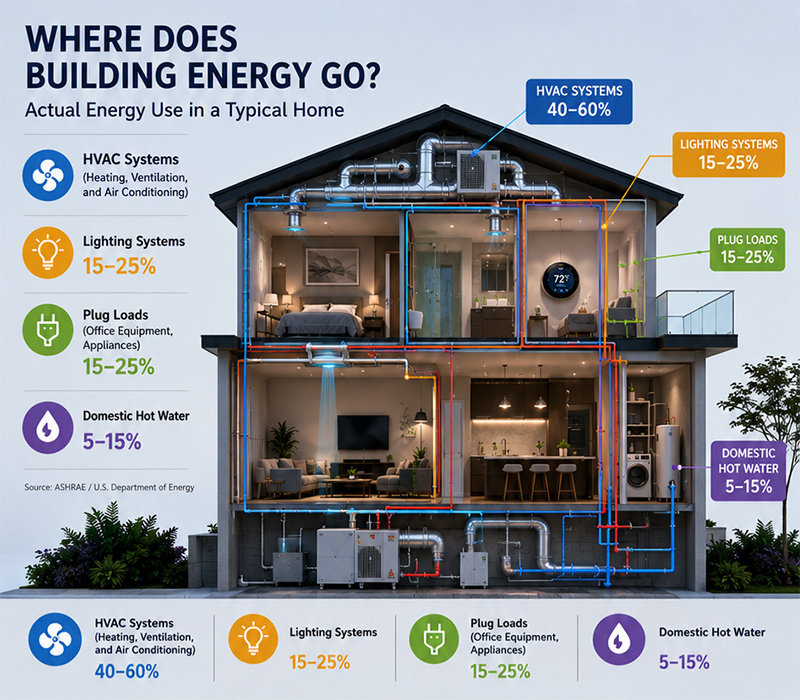
Studies on Energy Use Intensity (EUI) show that HVAC systems account for the largest share of energy consumption in most residential and office buildings. The overall distribution of building energy use is generally divided among the following systems:
- HVAC systems (heating, ventilation, and air conditioning): 40–60%
- Lighting systems: 15–25%
- Plug loads (such as office equipment and household appliances): 15–25%
- Domestic hot water: 5–15%
That’s why improving the efficiency of these systems plays a key role in reducing energy consumption.
What’s the Difference between Traditional and Modern Buildings?
Traditional MEP strategies improve efficiency, but they still rely on fixed systems and assumptions while Modern buildings are moving beyond that toward systems that think, react, and adapt in real time. This is where things start to change.
For an example: In one of the residential projects handled by Fast-Build in Huntington Park, California, the homeowner complained that his winter electricity bill was three times higher than his neighbor’s. When we checked, we found that the HVAC system was running at full capacity across the entire unit without any sensors even though half the rooms were empty during the day. After adding just two motion sensors and one smart thermostat, energy consumption dropped by 34% that same winter.
Smart MEP systems and modern solutions
What are smart MEP systems?
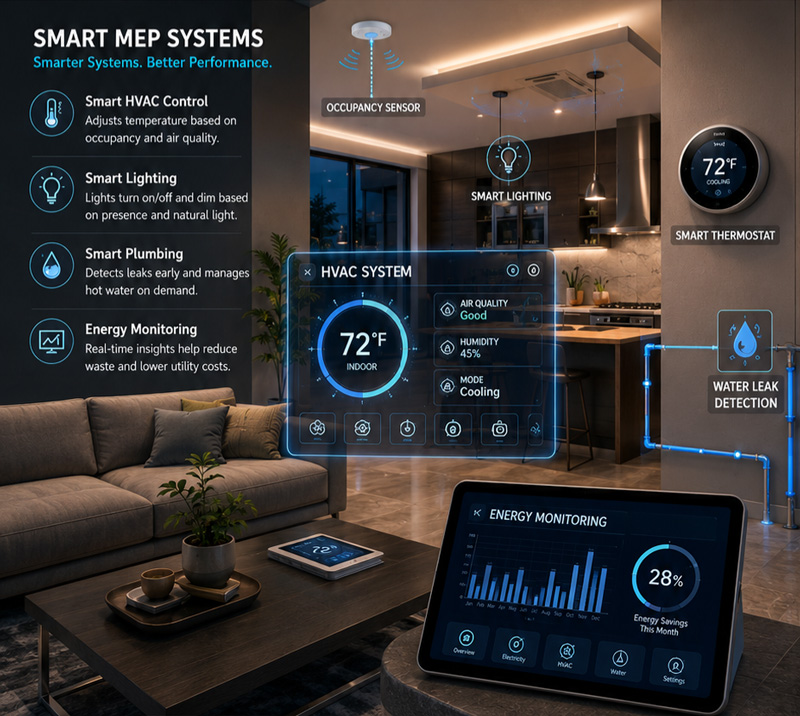
Smart MEP systems are building systems that use modern technologies to operate more intelligently and efficiently. By integrating digital tools with mechanical, electrical, and plumbing infrastructure, these systems allow buildings to better manage energy, comfort, and daily operations.
How do they work?
These systems operate through a network of sensors, automation tools, and digital control platforms. Sensors placed throughout the building collect information about conditions such as temperature, occupancy, and indoor air quality. This data is then processed by control systems that automatically adjust building operations, allowing heating, cooling, lighting, and other services to function according to real demand rather than fixed settings.
Why do they matter?
By responding to real-time conditions, smart MEP systems reduce unnecessary energy use while maintaining comfortable indoor environments. This approach improves operational efficiency, lowers energy costs, and allows buildings to perform more sustainably over time. As buildings become more complex, these intelligent systems play a key role in managing resources effectively and improving overall building performance.
For a home that performs as efficiently as it appears, professional MEP design is essential. FAST-BUILD delivers integrated, smart MEP solutions that reduce energy waste and lower operating costs.
Partner with us for a more efficient, reliable home.
In the next sections, we’ll look at how smart technologies are applied within different MEP systems. In particular, smart solutions in HVAC, electrical, and plumbing systems will be discussed to illustrate how intelligent design can significantly improve building performance and energy efficiency.
Smart HVAC Systems
Why HVAC Matters?
Heating, ventilation, and air conditioning systems account for a major share of a building’s total energy use. In many cases, they continue running even when spaces are empty, simply to maintain a fixed level of comfort.
What Changes with Smart Systems?
Smart HVAC systems move away from fixed schedules and manual control. Instead, they adjust their operation based on real-time conditions inside the building, such as occupancy, temperature, and air quality.
Occupancy-Based Control
If a room is not in use, there is no need to heat or cool it at full capacity. Occupancy sensors allow the system to reduce or pause operation in unused spaces, avoiding unnecessary energy consumption.
Air Quality Optimization
In addition to temperature control, smart systems also monitor CO₂ levels and indoor air quality. This ensures that fresh air is provided only when it is actually needed, rather than constantly running ventilation at full power.
This way the system becomes more responsive to how the building is actually used. This leads to lower energy waste and a more consistent, comfortable indoor environment without constant manual adjustments.
Smart Electrical Systems
Hidden Energy Consumption in Buildings
Lighting and electrical systems are often responsible for unnoticed energy waste. In many cases, lights remain on in empty spaces and devices continue drawing power even when they are not needed.
A More Responsive Approach to Electricity Use
Smart electrical systems address this issue by adjusting power consumption based on real-time conditions rather than fixed assumptions.
Lighting That Reacts to Presence
Instead of manual switching, lighting systems respond to occupancy. When a space is no longer in use, lights automatically turn off, reducing unnecessary energy use without relying on human action.
Using Natural Light More Effectively
These systems also take advantage of daylight. When sufficient natural light is available, artificial lighting is reduced or dimmed, maintaining visual comfort while lowering electricity demand.
Smart monitoring tools provide a clearer picture of how electricity is consumed across the building. This helps reveal patterns that would otherwise go unnoticed and supports better decision-making in energy management.
Smart Plumbing Systems
The Overlooked Side of Energy Use
Water systems are often underestimated when it comes to energy efficiency, yet they have a direct impact on overall building performance. Heating, pumping, and wasting water all contribute to energy consumption in ways that are not always visible.
A Shift Toward Smarter Water Management
Smart plumbing systems introduce a more controlled and responsive way of managing water use inside buildings.
Real-Time Monitoring and Leak Detection
Instead of reacting after a problem occurs, these systems continuously monitor water flow and system behavior. One of their key functions is early leak detection, where even small and hidden leaks can be identified before causing major water and energy loss.
On-Demand Hot Water Control
Hot water systems are also optimized through demand-based operation. Rather than keeping water constantly heated, smart systems adjust production according to actual usage, reducing unnecessary energy consumption while maintaining availability.
Tracking Water Usage Patterns
Some systems go a step further by analyzing long-term consumption data. This helps identify inefficient usage patterns and areas where water is being wasted, improving overall system performance.
Benefits of Smart MEP Design
Smart MEP design offers several practical advantages for both homeowners and building operators.
Lower Energy Consumption
By adjusting system operation based on real-time conditions such as occupancy, temperature, and daylight, smart MEP systems reduce unnecessary energy use.
Reduced Utility Costs
When heating, cooling, lighting, and water systems operate more efficiently, overall energy bills naturally decrease over time.
Improved Indoor Comfort
Smart systems maintain more stable indoor conditions by continuously responding to changes in the environment and building usage.
Better Resource Management
Monitoring tools help identify where energy or water is being wasted, making it easier to optimize building performance.
Longer Equipment Lifespan
Systems that operate only when needed experience less mechanical stress, which can extend the life of HVAC equipment, pumps, and other building systems.
Getting these systems designed, coordinated, and stamped correctly is its own discipline. If your project is in San Diego, see our MEP design San Diego page.
Conclusion
MEP systems play a central role in how efficiently a building operates. When these systems are designed with smart technologies, buildings can respond to real conditions instead of running on fixed assumptions.
The result is a home that uses less energy, operates more efficiently, and provides a more comfortable living environment.
Efficiency is not an option, it is requirement.
We ensure your homes mechanical, electrical and plumbing systems work together seamlessly at FAST-BUILD.
Contact us and experience the difference of intelligent design.