
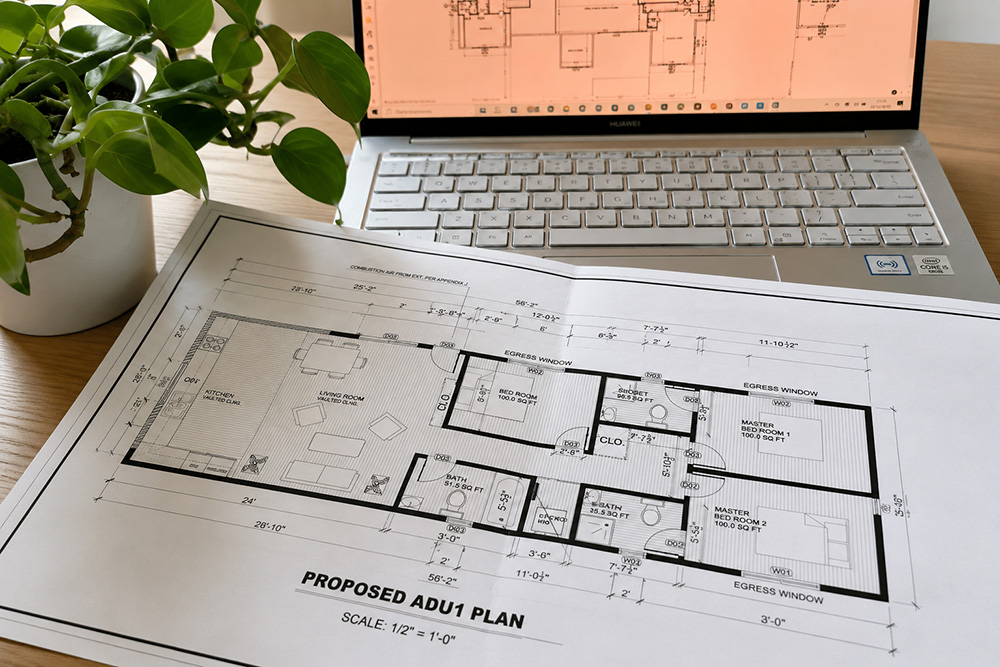
In our previous articles, we explored the different types of ADUs and their benefits for various homeowners. But before diving deeper, it’s worth quickly answering: What is an ADU?
An ADU, or Accessory Dwelling Unit, is a secondary residential space built on the same lot as a primary home. It can be attached to or detached from the main house and functions as an independent living area with its own entrance, kitchen, and bathroom.
In this article, we’ll focus specifically on the attached ADU — a type of Accessory Dwelling Unit that shares at least one wall with the main house. Attached ADUs are typically smaller and more affordable to build than detached units. They offer unique advantages, but also come with certain limitations like reduced privacy for tenants.
We’ll look at a real project example — a garage conversion in Corona, California — to show how thoughtful design can turn an underused space into a valuable, income-generating unit.
What Is an Attached ADU?
An attached ADU is a self-contained living unit that is physically connected to the primary home, sharing one or more walls. It has its own private entrance, kitchen, and bathroom, and is legally separate from the main dwelling.
| California Government Code: “An ADU is an attached or detached residential dwelling unit that provides complete independent living facilities for one or more persons and is located on a single lot with a proposed or existing single-unit dwelling.” — halfmoonbay.gov |
Common examples of attached ADUs include:
- Converted attached garages
- Additions built onto the side or rear of the home
- Converted basements with a separate entrance
- In-law suites or mother-in-law units
Attached ADU Size Limits in California (2026)
One of the most common questions homeowners ask is: how big can an attached ADU be?
Under California law, an attached ADU can be:
- Up to 50% of the primary home’s floor area, or
- Up to 850 sq ft for a studio or 1-bedroom unit
- Up to 1,000 sq ft for a 2-bedroom unit — whichever is less
Some cities like Los Angeles may have additional rules, so it’s always worth checking with your local jurisdiction before finalizing your plans. The maximum height for an attached ADU is typically 25 feet or the local zoning height limit for the primary dwelling — whichever is lower.
Attached ADU Cost in California (2026)
The cost of building an attached ADU in California generally ranges from $120,000 to $300,000, depending on size, location, and finish level. This makes attached ADUs significantly more affordable than detached ADUs, which typically cost $180,000 to $400,000 or more.
Here’s why attached ADUs cost less:
- They don’t require a separate foundation
- They share at least one exterior wall with the main home
- Existing plumbing and electrical connections can often be extended rather than built from scratch
- Garage conversions are the most cost-effective option since the structure already exists
The Corona ADU project by FastBuild — covered below — is a great example of how a garage conversion can dramatically reduce construction costs while still delivering a fully functional, rentable unit.
Advantages of an Attached ADU
1. Lower Construction Cost
Because attached ADUs share a wall (and often utilities) with the main house, they cost significantly less to build than detached units. If you’re converting an existing garage or interior space, costs can be even lower since the structural shell is already in place.
2. Ideal for Smaller Lots
Attached ADUs require less land than detached units, making them the best option for homeowners with limited outdoor space. They blend into the existing footprint of the home without consuming your entire backyard.
3. Great for Multi-Generational Living
Attached ADUs are especially popular with multi-generational families. They provide enough separation for privacy — through a separate entrance and living space — while keeping family members close. This setup works well for aging parents, adult children returning home, or extended family.
4. Home Office or Guest Space
An attached ADU doesn’t always have to be a rental unit. Many homeowners use them as a dedicated home office, art studio, or guest suite — separate enough from the main living area to feel distinct, but connected enough to be convenient.
5. Increases Property Value
A well-designed attached ADU adds meaningful value to your property. In California’s competitive real estate market, a permitted ADU — especially one ready for rental income — is a significant selling point.
Disadvantages of an Attached ADU
1. Less Privacy Than a Detached Unit
The shared wall means that noise from the main house can travel into the ADU and vice versa. This is the most common concern for homeowners who plan to rent the unit out, since tenants — particularly students or remote workers — tend to prioritize quiet. This can be addressed with proper soundproofing in the shared wall, which adds some upfront cost but pays off in tenant satisfaction and rental income over time.
2. Shared Facilities Can Be a Limitation
In some attached ADU configurations — particularly smaller ones — the unit may share a bathroom or laundry with the main house. Tenants generally prefer fully self-contained units. If you’re building primarily for rental income, it’s worth investing in a complete, private unit from the start.
3. Design Constraints
Because the ADU is attached to an existing structure, the design is more constrained than starting from scratch. You have to work with the existing layout, structural elements, and building envelope. This is where experienced architectural and structural design makes a real difference.
Corona ADU by FastBuild — A Real Project Example
Project Overview
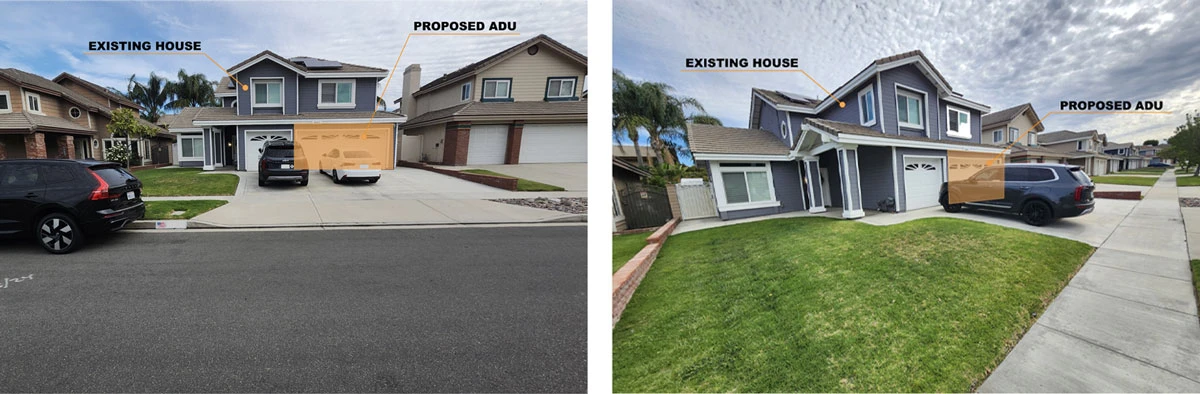
One of the clearest examples of a well-executed attached ADU design is this garage conversion project in Corona, California. The homeowner wanted to convert an existing attached garage into a rentable unit to generate additional income — without sacrificing parking on the lot.
The picture below shows the original floor plan of the house, with the proposed ADU location marked in red.
Design Features and Layout
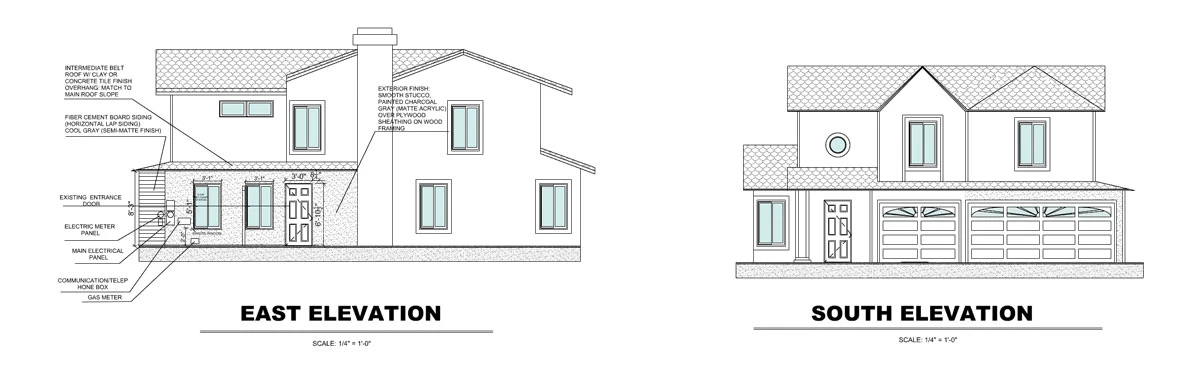
The garage space was transformed into a fully private ADU — which, compared to many attached ADUs, functions almost like a detached unit in terms of privacy. Key design decisions included:
- A dedicated bathroom was designated exclusively for the ADU, taken from the existing home layout
- A kitchen and bedroom were added, giving the unit everything a tenant needs for independent living
- The unit has its own private entrance that opens directly into the kitchen and living area
- An open floor plan was used intentionally, allowing the space to be reconfigured in the future — maximizing long-term property value
Cost Efficiency and Results
Because the unit was built within the existing garage structure, the construction cost was significantly lower than a comparable detached ADU. Even with the addition of a new HVAC unit, the overall expense stayed well below what new ground-up construction would have cost.
The shared wall was insulated for sound, creating a quieter, more comfortable environment for tenants. One parking space was maintained on the lot — an important consideration in California where parking requirements are often part of the permitting process.
Despite the compact footprint, the finished unit feels spacious and comfortable — largely due to the open layout and thoughtful use of the available space.
Attached ADU vs Detached ADU — Which Is Right for You?
| Attached ADU | Detached ADU | |
| Cost | $120K – $300K | $180K – $400K+ |
| Privacy | Moderate | High |
| Lot Space Required | Less | More |
| Best For | Family use, smaller lots, budget builds | Rental income, maximum privacy |
| Construction Time | Shorter | Longer |
| Rental Premium | Standard | $200–$500/mo more |
If your priority is rental income and maximum tenant privacy, a detached ADU gives you more flexibility. If you have a smaller lot, a tighter budget, or are building for family use, an attached ADU is usually the better choice.
Frequently Asked Questions About Attached ADUs in California
Yes. California law requires that an ADU have its own private entrance independent of the main house. An ADU accessed only through the main dwelling cannot be legally rented.
Yes. Garage conversions are one of the most popular and cost-effective types of attached ADUs in Los Angeles. You’ll need permit-ready architectural and structural drawings submitted to LADBS, along with Title 24 energy compliance documentation. FastBuild handles all of this for homeowners throughout Southern California.
The permitting process typically takes 4 to 12 weeks depending on your city or county. Design and plan preparation takes 4 to 8 weeks, and construction typically takes 3 to 5 months. The full process from design to move-in is usually 6 to 12 months.
In California, permit-ready ADU plans must be prepared and signed off by a licensed architect or engineer. Submitting drawings without proper licensing will result in rejection by the building department, causing delays and added costs.
An attached ADU can be up to 50% of the primary home’s floor area, with a maximum of 850 sq ft for a studio or 1-bedroom, and 1,000 sq ft for a 2-bedroom unit.
Yes. Attached ADUs can be rented as long as they are fully permitted and have their own independent entrance, kitchen, and bathroom. California removed owner-occupancy requirements for ADUs in 2020, making it easier to rent both the main house and the ADU at the same time.
Planning an attached ADU in San Diego? Our ADU designer San Diego page covers local setbacks, size limits, and the permit path.
Conclusion
An attached ADU is one of the most practical and affordable ways to add livable space or rental income to your California property — especially if you have a smaller lot or an existing attached garage to work with.
The key is thoughtful design. A well-planned attached ADU — like the Corona project by FastBuild — can overcome the privacy and noise challenges that sometimes come with shared-wall construction, delivering a unit that tenants genuinely want to live in.
When planning an ADU in Los Angeles or anywhere in Southern California, choosing the right type of ADU for your specific lot, budget, and goals makes all the difference.
| Ready to Build an Attached ADU in California? FastBuild is a licensed architectural and structural engineering firm serving Los Angeles, San Diego, and all of Southern California. We prepare complete, permit-ready ADU plan sets so your project gets approved the first time. Get a Free Consultation No commitment. Just clear answers about your project, your lot, and what it will take to get permitted. |