
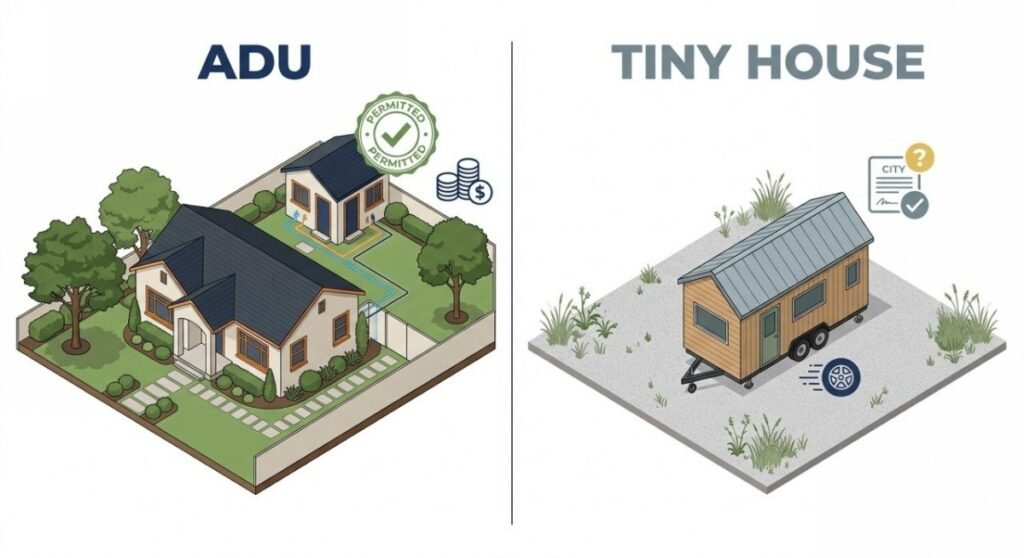
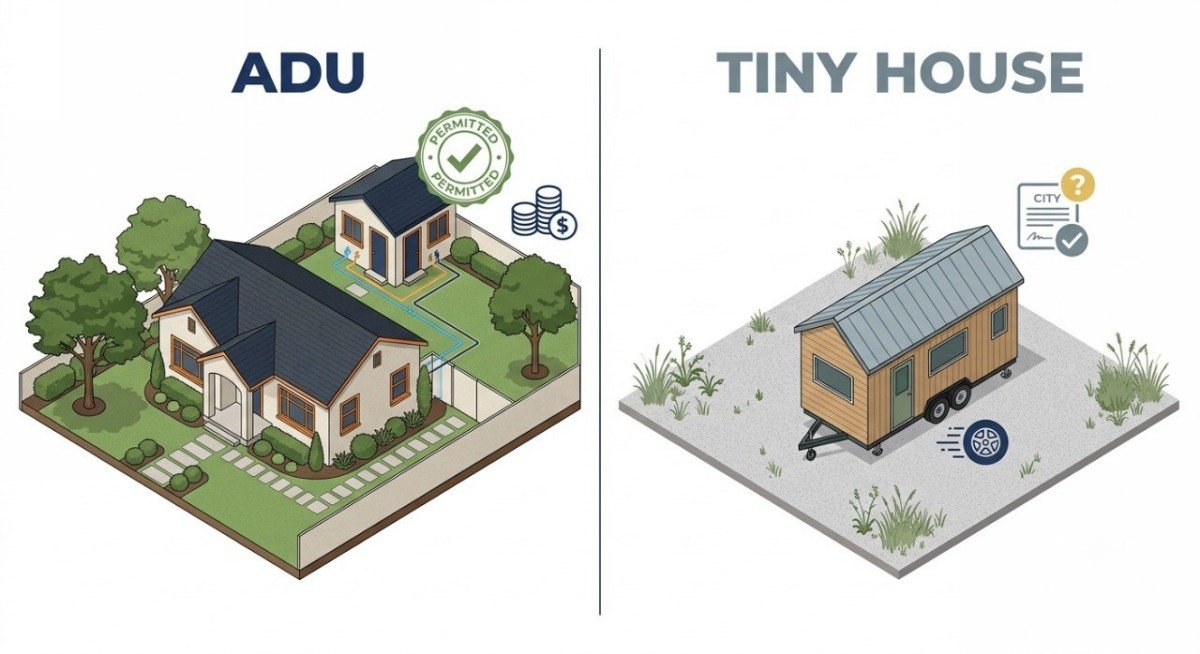
With housing costs rising across California and most of the U.S., more homeowners are looking at smaller, more affordable options. Two that come up frequently are ADUs and tiny houses. They look similar on the surface — both are compact, both are designed for independent living — but they are fundamentally different in how they are built, how they are regulated, and what they can do for you long-term.
This article breaks down the real differences of ADU vs tiny house so you can make an informed decision for your property and your goals.
What Is a Tiny House?
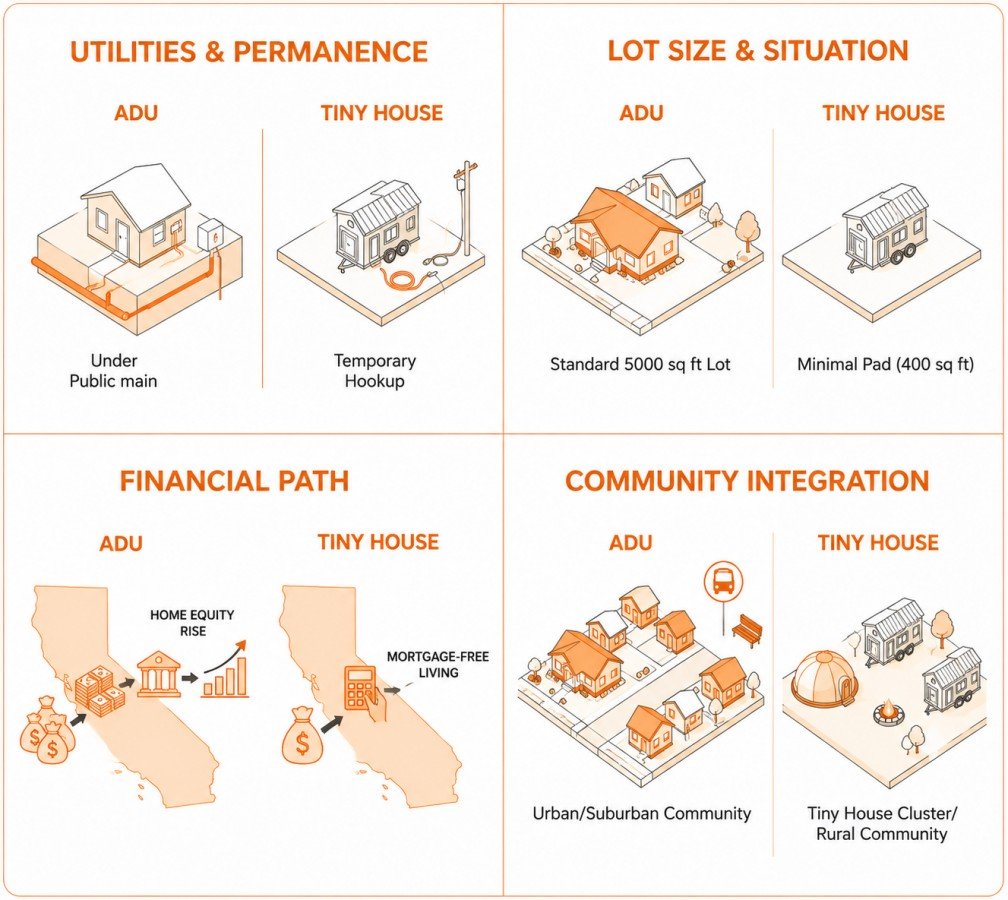
A tiny house is generally defined as a structure under 400 square feet. It can be built on a permanent foundation or placed on wheels. When it is on wheels, it is treated more like a vehicle — movable, but also subject to different regulations than a permanent structure.
In 2018, the International Building Code updated its standards to include tiny houses, which gave the concept a more formal regulatory framework. The appeal of tiny houses goes beyond just cost — they attract people who value minimalism, mobility, and a simpler way of living. Every square foot has to earn its place, which leads to creative storage solutions, multi-purpose furniture, and efficient use of space.
“Tiny house” is a broad term that covers many different forms of small living: structures on foundations, units on wheels, converted shipping containers, and sometimes even RVs or converted vans. The one thing they share is size — small — and a design philosophy that prioritizes simplicity over square footage.
What Is an ADU?
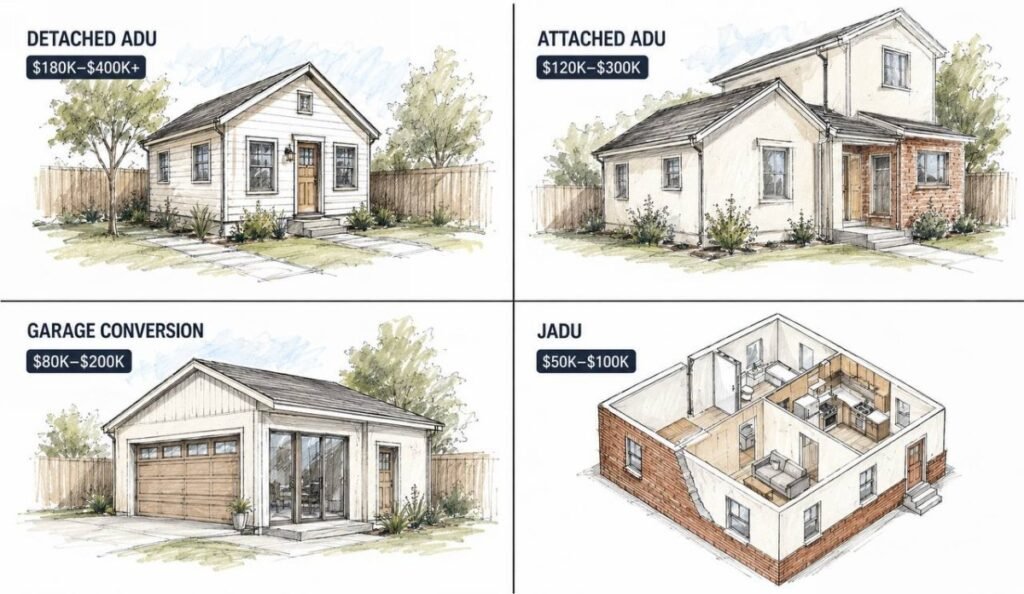
An ADU (Accessory Dwelling Unit) is a secondary dwelling unit on a lot that already has a primary residence. It can be attached to the main house (Attached ADU), detached in the backyard (Detached ADU), or converted from an existing structure like a garage (Garage Conversion). Unlike a tiny house, an ADU is always a permanent, permitted structure — legally part of the property it sits on.
In California, you can sometimes build two ADUs on the same property: one Junior ADU (JADU) of up to 500 square feet inside the existing home, and one full ADU in the backyard or garage. ADU in Los Angeles has become one of the most practical housing solutions in the region, partly because California law has progressively removed local restrictions that previously blocked ADU construction.
Legal Status in California: Where Each Option Stands
This is the most important difference for California homeowners — and the one that gets the least attention in most comparisons.
ADUs are fully legal, fully supported, and actively encouraged by California state law. They must meet all building codes, but the permit process is streamlined and cities are prohibited from blocking reasonable applications. A permitted ADU is part of your official property record, can be legally rented, and adds to your property’s assessed value.
Tiny houses on wheels occupy a much more ambiguous legal space in California. They are classified as vehicles, not structures, which means they cannot be permanently sited on most residential lots without special approval. Most California cities do not allow them as permanent dwellings. Even tiny houses on foundations face stricter scrutiny than ADUs in many jurisdictions — they may need to meet tiny house building codes, specific zoning allowances, or be classified differently depending on the city.
If you are in Los Angeles, San Diego, or any major California city, and you want a legally recognized secondary unit that you can rent, permit, and include in your property value — an ADU is the clear choice. A tiny house on wheels may work as a personal living experiment, but it cannot reliably serve as a permitted, income-generating rental unit in most California jurisdictions.
Cost Comparison: ADU vs Tiny House
Tiny houses cost less upfront — typically $20,000 to $100,000 depending on size, materials, and whether you are buying pre-built or building from scratch. Ongoing costs are also lower: less energy, less maintenance, and no land purchase required if you already own property.
ADUs cost more to build — the range depends heavily on the type:
- Detached ADU (new construction): $180,000 – $400,000+
- Attached ADU: $120,000 – $300,000
- Garage conversion ADU: $80,000 – $200,000
- JADU (within existing home): $50,000 – $100,000
The cost difference, however, has to be weighed against income potential. A permitted ADU in California can generate $1,500 to $3,000 or more per month in rental income. A tiny house on wheels typically cannot be legally rented in most California cities. An ADU that rents for $2,000 per month pays back its construction cost within 5 to 10 years and continues generating income indefinitely. A tiny house does not have that return path in most markets.
Design and permit fees for an ADU are typically $2,000 to $10,000 on top of construction costs. ADUs under 750 square feet are often exempt from impact fees in California, which can save thousands.
Size and Space: What You Actually Get
Tiny houses max out at around 400 square feet — and many are much smaller. That requires creative thinking about every square foot: lofted sleeping areas, fold-down furniture, built-in storage under every surface. It works, but it demands a lifestyle adjustment that not everyone is ready for.
ADUs can be significantly larger. Detached ADUs in California can be up to 1,200 square feet. Even small ADUs — like our Malabar 6530 project, designed at 320 square feet — are built to full residential standards with proper egress, minimum bedroom sizes, code-compliant bathrooms, and permitted kitchens. Every room meets the same requirements as a full home. A 320 square foot ADU is small, but it is a complete, legal, rentable unit.
One specific rule worth knowing: bedrooms in an ADU must be at least 100 square feet of net floor area, not counting closets. This applies to every ADU project regardless of total size and is enforced in plan check.
Environmental Impact
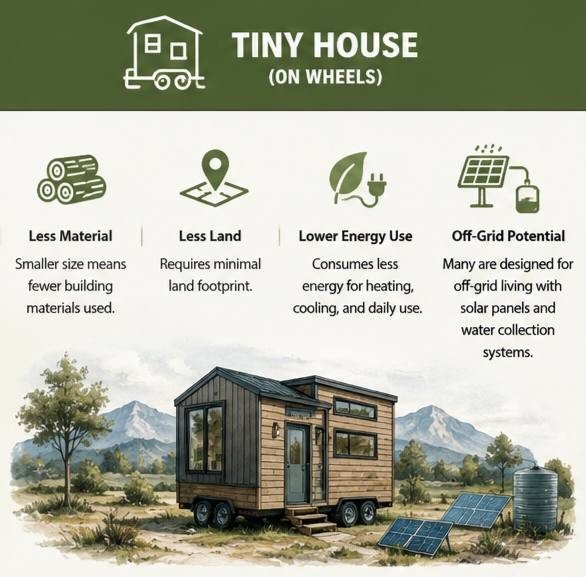
Both options have environmental advantages over conventional housing. Tiny houses use less material, occupy less land, and consume less energy. Some are designed for off-grid living with solar panels and water collection systems — a real benefit for anyone prioritizing self-sufficiency.
ADUs are typically connected to the main property’s utilities, which means grid-tied systems rather than off-grid solutions. That said, California’s Title 24 energy compliance requirements — mandatory for all new ADU construction — ensure that ADUs meet strict energy efficiency standards. A well-designed ADU with proper insulation, efficient HVAC, and energy-compliant windows and lighting performs significantly better than an older home of the same size.
Lifestyle: Mobility vs Stability
The lifestyle difference between a tiny house and an ADU comes down to one question: do you want to move, or do you want to stay?
Tiny houses on wheels offer genuine mobility — you can relocate, try different areas, or follow opportunities without being tied to a fixed address. For people who prioritize flexibility and simplicity, that freedom is real. The trade-off is the legal ambiguity that comes with it: finding legal places to park long-term can be difficult, and the unit does not build property equity the way a permitted structure does.
ADUs are permanent — and that permanence is also their strength. They are part of the property, legally recognized, financeable, and transferable when the home sells. For homeowners who want to house a family member, generate rental income, or simply add long-term value to their property, an ADU delivers in ways a tiny house cannot.
ADU vs Tiny House: Side-by-Side Comparison
| ADU | Tiny House | |
| Legal status in CA | Fully permitted, part of property record | Ambiguous — on wheels = vehicle; foundation = varies by city |
| Cost to build | $50K – $400K+ depending on type | $20K – $100K |
| Rental income potential | Yes — legally rentable in California | Limited — most CA cities do not allow as permanent rental |
| Maximum size | Up to 1,200 sq ft (detached) | Under 400 sq ft by definition |
| Permanence | Permanent structure, adds to property value | On wheels: movable; on foundation: varies |
| Permitting | Required — full permit package needed | On wheels: fewer requirements; on foundation: city-specific |
Frequently Asked Questions: ADU vs Tiny House
Is a tiny house the same as an ADU?
No. A tiny house is defined by size — under 400 square feet — and can be on wheels or a foundation. An ADU is a secondary dwelling unit on a lot with a primary residence and is always a permanent, permitted structure. A tiny house could technically qualify as an ADU if it is on a permanent foundation, meets all local building codes, and is permitted — but most tiny houses do not meet those requirements.
Can I put a tiny house on my property in California?
It depends on your city and whether the tiny house is on a foundation or wheels. Tiny houses on wheels are classified as vehicles in California and cannot be permanently sited on most residential lots. Tiny houses on foundations may be allowed in some jurisdictions, but they face more regulatory uncertainty than ADUs. If you want a legally permitted, rentable secondary unit, an ADU is the more reliable path in California.
Which is cheaper — an ADU or a tiny house?
A tiny house typically costs less upfront: $20,000 to $100,000 versus $50,000 to $400,000 for an ADU depending on type. However, an ADU can generate rental income in California, which a tiny house on wheels generally cannot. Over a 10-year period, a rented ADU often recovers its construction cost and continues generating income. A tiny house does not have that return path in most California markets.
What is the minimum size for an ADU in California?
An efficiency unit ADU can be as small as 150 square feet under California law. In practice, most ADUs are significantly larger to meet livability standards — bedrooms must be at least 100 square feet of net floor area, and the unit needs a kitchen, bathroom, and separate entrance. Our smallest completed ADU project is 320 square feet — fully permitted, fully compliant, and legally rentable.
Thinking About Adding a Secondary Unit to Your California Property? If your goal is a legally permitted, income-generating unit that adds long-term value to your property, an ADU is almost always the right choice in California. We evaluate your lot, recommend the best ADU type for your situation, and handle the full permit package — architecture, structural, and MEP — in-house.